Most appraisal firm websites have one services page. It lists everything the firm does in a handful of bullet points, residential, commercial, industrial, litigation, insurance, all mixed together under a single heading. It looks complete. It’s actually the reason a lot of qualified firms stay hard to find.
The problem isn’t that the information is missing. It’s that a single page can’t match the way three very different types of clients actually search. Here’s the structure that does.
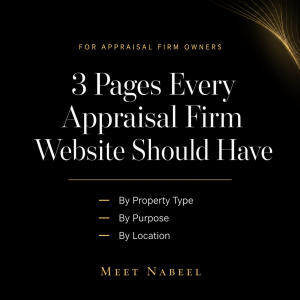
1. A page for each property type you actually appraise
A lender needing a valuation on a warehouse and a homeowner’s lawyer needing a valuation on a house are not searching the same way, and they’re not reading the same page well if you force them onto one. “Industrial property appraisal,” “vacant land appraisal,” “retail property appraisal,” and “certified residential appraisal” are different searches with different intent behind them, and each deserves its own page.
This matters beyond SEO. The comparable approach, the report format, and the client’s actual concerns change by property type. A retail appraisal page can talk about tenant mix, lease structures, and market rent, none of which belongs on a residential page. Writing separate pages forces you to actually explain your process for that asset class instead of relying on one vague paragraph that tries to cover everything and ends up saying very little about any of it.
If you handle three or four core property types, build a page for each one you genuinely want more of. Don’t build a page for a property type you rarely take on just to look comprehensive. It dilutes the pages that matter and signals less depth, not more.
2. A page for each reason someone needs an appraisal
This is the one most firms skip entirely, and it’s often more valuable than the property-type pages. The property being appraised is only half of what a client is searching for. The other half is why they need the appraisal, and that “why” changes everything about who’s searching, how urgently, and what they need from the report.
A lawyer preparing for a matrimonial matter needs a retrospective valuation that will hold up if it’s challenged. An executor handling an estate needs a valuation as of a specific date of death, often under time pressure from probate deadlines. A property owner disputing a capital gains reassessment needs a report that speaks the CRA’s language. A homeowner refinancing needs something fast, straightforward, and lender-compliant. These are four completely different searches, “estate appraisal for probate,” “appraisal for capital gains,” “litigation appraisal report,” “financing appraisal,” and four completely different clients, even if the underlying property type is identical in all four cases.
A single “appraisal services” page can’t serve all four of these searchers at once, because each one is looking for signals that you understand their specific situation, not just that you appraise property. A page built around tax and estate purposes should talk about effective dates, probate timelines, and CRA scrutiny. A page built around litigation and matrimonial matters should talk about court-defensible methodology and retrospective valuations. That specificity is what makes a lawyer or accountant trust you before they’ve even called.
3. A page for each core market you actually serve, built with real local detail
A location page only works if it earns its place. “We proudly serve Markham and the surrounding area” swapped into six different city names is thin content, and both Google and your reader can tell. A location page needs something a generic page doesn’t have: awareness of how appraisal needs actually differ in that market. Zoning quirks in a specific municipality, the mix of property types common to that area, how local assessment or municipal processes affect timelines there.
Build a location page for each market where you have real, active work, not every city within driving distance. Three well-built location pages for markets you actually serve outperform ten thin ones that all read the same. If you’re expanding into a new market and don’t have that local detail yet, it’s worth building the page once you do rather than publishing a placeholder now.
Why this structure matters more than any single page
None of these three page types work in isolation. A property-type page tells Google and the reader what you appraise. A purpose page tells them why someone would need you. A location page tells them where. Together, they let a search for “estate appraisal in Markham” or “industrial appraisal for financing in Vaughan” find a page built specifically for that exact situation, instead of hoping your one general services page happens to rank for everything.
This is also where the pages connect to each other. A purpose page like litigation appraisals should link to the relevant property-type pages it applies to, and a location page should link out to the property types and purposes most common in that market. That cross-linking is what tells search engines your site has real depth on the topic, not just a list of keywords.
If your site currently has one page trying to do the job of ten, that’s usually the highest-value fix available before spending anything on ads. It’s also the kind of restructuring that SEO built specifically for appraisal firms is designed to identify, page by page, based on what your actual clients are searching for.
Not sure which pages would move the needle first for your site. Book a Strategy Call and I’ll go through your current structure with you.