Why Generic Marketing Agencies Get Appraisal Firms Wrong
Most marketing agencies have a playbook. Find the local service business, run the same package, local SEO, a Google Ads campaign, a handful of social posts, swap out the industry name, and repeat. That playbook works reasonably well for plumbers, dentists, and landscapers, businesses where a stranger with a problem searches, calls, and books. It breaks down almost immediately when applied to an appraisal firm, and it breaks down in ways that go well beyond wasted ad spend.
Here’s exactly where the mismatch happens, and why it matters more for this profession than most.
They target the client who can’t actually choose you
A generic agency’s first instinct is to chase mortgage-related searches, “home appraisal,” “property valuation for mortgage,” because that sounds like the obvious volume play. The problem is structural, not tactical. Most mortgage-lender appraisal orders in Canada and the US go through an Appraisal Management Company or an internal lender panel specifically so the lender can’t select or directly contact an appraiser for a given file. That firewall exists on purpose. No amount of ranking or ad spend changes who an AMC rotates a file to.
An agency that doesn’t understand this will still run campaigns chasing that traffic, because on paper it looks like the highest-volume keyword category. The appraiser pays for clicks that were never going to become a client relationship, no matter how well the ad performed. This isn’t a small inefficiency. It’s the single most common way appraisal firm marketing budgets get wasted, spending against demand the firm has no ability to convert.
They don’t know the difference between an appraisal and an estimate
This is a subtler version of the same mistake. A generic agency building keyword lists for “home valuation” or “what’s my house worth” is often pulling in searchers looking for a free, instant, automated estimate, the kind Zillow-style tools produce, not someone looking to pay for a licensed appraisal. These are fundamentally different searches with fundamentally different intent, and an agency unfamiliar with the industry frequently can’t tell them apart. The result is a campaign that generates plenty of clicks and very few actual inquiries, because the traffic was never looking for what the firm sells in the first place.
They write copy that risks the appraiser’s own ethics obligations
This is the mistake that should concern firm owners the most, and it’s the one a generic copywriter has no way of knowing to avoid. Appraisers operate under standards, USPAP in the US and CUSPAP in Canada, that explicitly prohibit advertising in a manner that is false, misleading, or exaggerated. The same standards require an appraiser to remain independent, impartial, and free from any suggestion of predetermined conclusions or advocacy for a particular outcome.
A generic marketing agency doesn’t know any of this. Their default playbook leans on urgency and outcome-driven promises, “get the value you need,” “we’ll help you win your case,” “guaranteed results,” because that’s what converts in industries where making a bold promise is just aggressive marketing, not a professional liability. For an appraiser, language like that doesn’t just sound unprofessional. It can read as advocacy or a predetermined outcome, which is precisely what the ethics rules governing the profession are built to prevent. A firm that lets a generic agency write its ad copy is trusting language decisions to someone with no idea they’re operating inside a regulated profession’s advertising restrictions.
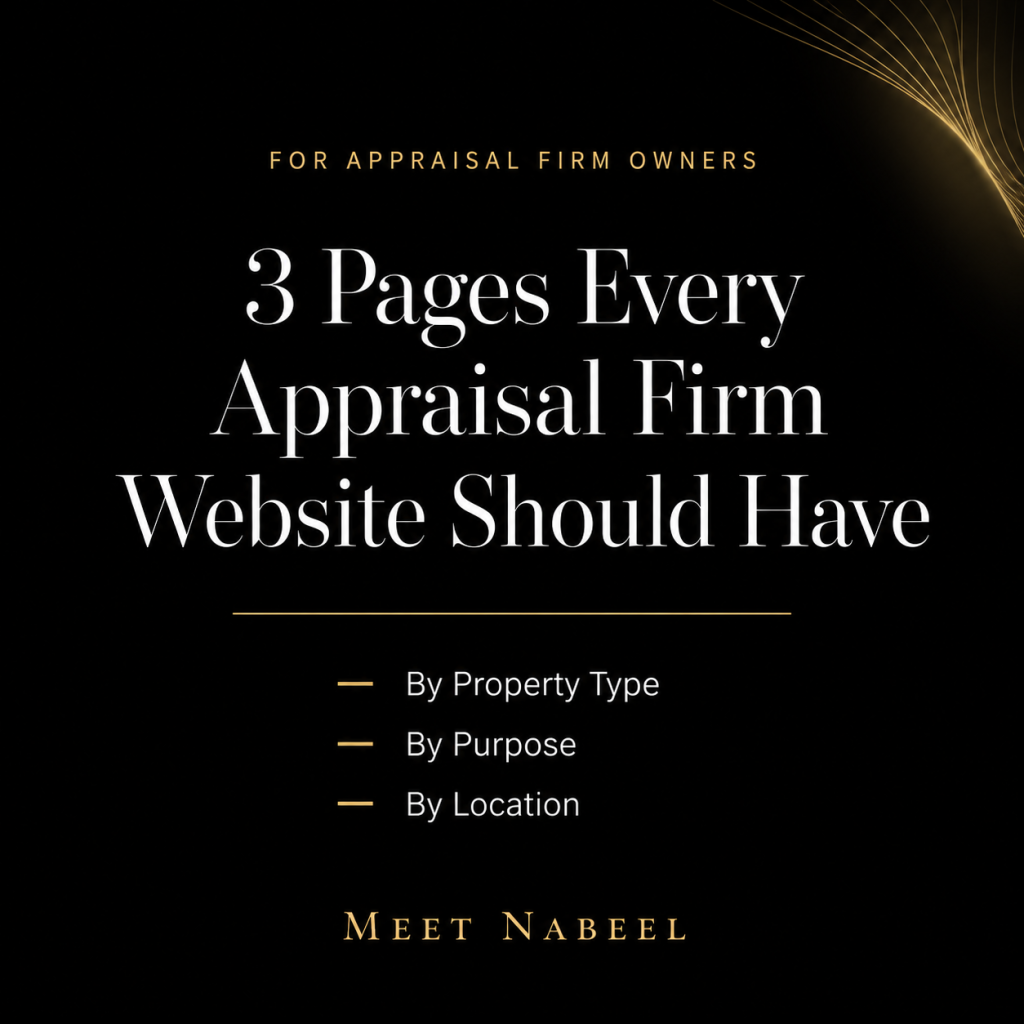
They build one page where the client actually needs several
A generic agency’s default is a single “Services” page listing everything the business does in a handful of bullet points. That’s a reasonable structure for a business with one type of client asking one type of question. It fails an appraisal firm because the reasons someone needs an appraisal are wildly different from each other, and each one represents a different search, a different searcher, and a different set of concerns.
A lawyer preparing for a matrimonial matter needs a retrospective valuation that will hold up if it’s challenged. An executor handling an estate needs a valuation as of a specific date, often under a probate deadline. A property owner disputing a tax assessment needs a report that speaks to that specific process. A homeowner refinancing needs something fast and lender-compliant. A single generic services page, written by someone who doesn’t understand these differences, ends up saying very little to any of them. This is one of the most common, and most fixable, gaps a generic agency leaves behind.
They chase “national” reach for a fundamentally local profession
Appraisers work under a geographic competency requirement, they need real, demonstrated knowledge of a market before they can responsibly value property in it. A generic agency, applying the same broad-reach thinking it would use for an e-commerce brand or a national service company, often pushes firms toward chasing visibility across an entire province or country before they’ve properly established themselves in their own city. The content that results is thin enough to apply anywhere, which means it’s specific enough to convince no one. A firm ends up with weak visibility everywhere instead of strong visibility where it actually operates.
They don’t understand how this business actually gets its clients
Most independent appraisers grow through referral relationships, lawyers, brokers, accountants, and past clients who trust their work and send more of it. A generic agency, trained to think in terms of consumer-style conversion funnels, tends to build campaigns around getting a stranger to fill out a form and convert immediately. That model doesn’t map well onto a business where the biggest wins often come from a referral partner recognizing your name months after they first came across it.
The smarter approach treats visibility as something that supports and reinforces the referral relationships that already drive the business, showing up credibly when a lawyer or broker searches for a specialist, staying visible enough that your name is recognizable when it does come up in conversation, rather than treating every visitor as someone who needs to convert on the first click. A generic agency, measuring success purely by form submissions and cost per lead, usually can’t see or value this kind of visibility at all.
They don’t know which credentials actually build trust with this audience
A generic agency writing for a landscaping company leans on reviews and before-and-after photos, because that’s what convinces a homeowner. An appraisal firm’s real audience, lawyers, lenders, executors, accountants, responds to a different set of signals: AACI, CRA, or P.App designations, familiarity with CUSPAP or USPAP compliance, sample report structure, and a clear explanation of methodology. A generic agency, unfamiliar with what actually matters to this audience, tends to default to generic trust signals that don’t move the needle for the client this business actually needs to convince.
What actually needs to happen instead
None of this means an appraisal firm needs a radically different kind of marketing. It needs marketing built by someone who understands the actual mechanics of the profession, the AMC firewall, the ethics rules around advertising language, the referral-driven growth pattern, and the geographic competency requirement that shapes how visibility should be built in the first place. Every mistake covered here comes from the same root cause: applying a playbook built for a different kind of business to one that doesn’t work that way.
The firms that get real, compounding value out of their marketing are the ones whose visibility strategy reflects how their business actually operates, not a template with the industry name swapped in.
Let’s talk about where your firm actually stands
If you want a straight, no-pressure look at whether your current marketing is chasing the wrong searches, using language that doesn’t fit the profession, or missing the parts of the market that actually convert, fill out the form below and I’ll get back to you directly.