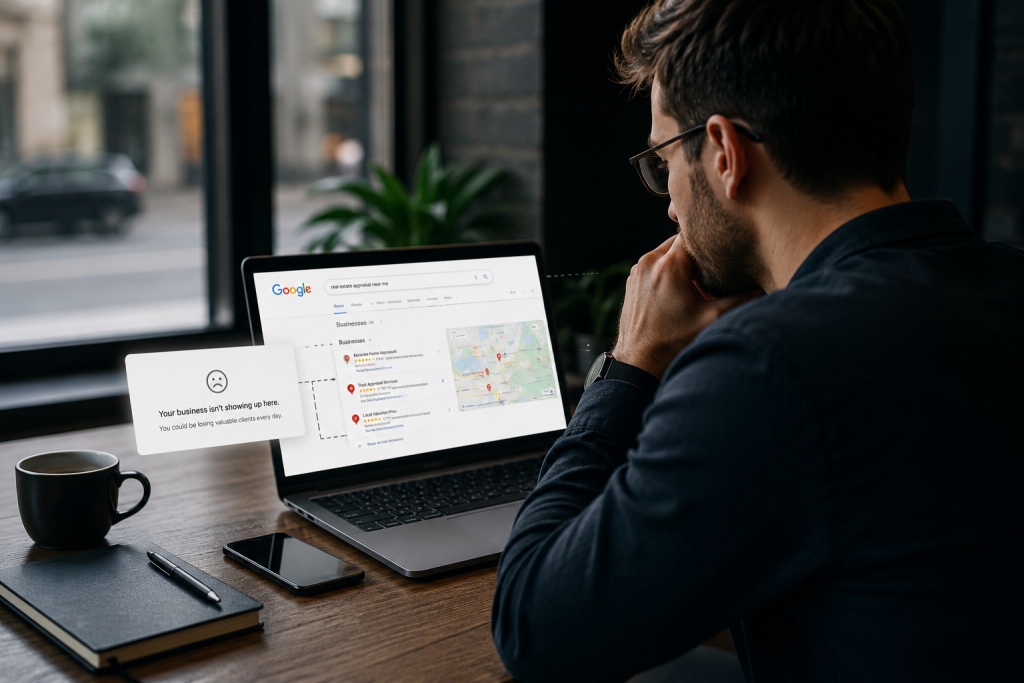
Local SEO vs. National SEO for Appraisal Firms: What Actually Matters
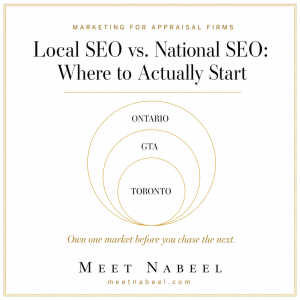
Ask most marketers how to grow an appraisal firm’s visibility online, and a lot of them will eventually pitch “national SEO,” ranking across the whole country, as the bigger, more impressive goal. For an appraisal firm, that’s usually the wrong target entirely. Not because bigger reach is bad, but because the whole idea of “national” doesn’t map onto how this business actually works, or how your clients actually search.
Here’s the right way to think about it: start with one location. Own it completely. Then expand, city by city, in a deliberate order, until the reach you’ve built is real instead of thin.
Why “national SEO” is the wrong frame for an appraisal firm
Think about what actually makes a national brand rankable nationally. A company selling software, or shipping a physical product anywhere in the country, genuinely serves every city it ranks for. Someone in Calgary and someone in Halifax can both become a real customer of the same national business on the same day.
An appraisal firm doesn’t work that way, and it’s not supposed to. CUSPAP, the standard every AIC member has to follow, requires geographic competency for every assignment. That means an appraiser has to actually understand the local market, comparable sales, zoning quirks, demographics, before they can responsibly value a property in that area. A Toronto-based appraiser can’t credibly serve Halifax the way a Toronto-based software company can. If you don’t have the market knowledge, the standard requires you to either build it or bring in someone local who has it.
So “ranking nationally” for a firm that can only credibly serve a handful of markets isn’t a growth strategy. It’s a mismatch between what you’re chasing and what you can actually deliver. Worse, chasing broad reach usually means the content is generic enough to apply anywhere, which means it’s specific enough to convince no one. A page trying to speak to appraisal clients in every province at once ends up speaking clearly to none of them.
What local SEO actually means, and why it starts narrow
Local SEO isn’t a smaller, lesser version of national SEO. It’s the correct model for a business that depends on geographic competency and physical presence. It means being the clear, obvious answer when someone in a specific city searches for an appraiser, not one of many results competing on a generic national page.
Say your firm is based in Toronto. The starting point isn’t “how do we rank in Ontario” or “how do we show up across Canada.” It’s “how do we own Toronto.” That means:
Your Google Business Profile is set up with the right categories, service areas, and consistent name, address, and phone details, so it shows up reliably in the map pack for searches like “property appraisal Toronto” or “home appraiser near me” from someone actually standing in Toronto.
Your website has a page built specifically around Toronto, not a generic “we serve Ontario” page, with content that reflects real knowledge of the city’s neighborhoods, condo market, and the kind of assignments that come up there specifically.
Your reviews, citations, and mentions are concentrated enough in that one city that Google has a clear, consistent signal about where you actually operate and who you actually serve.
This is why a firm that fully owns Toronto searches will consistently outperform a firm spreading thin content across ten cities it barely has a presence in. Depth beats breadth when the underlying business is inherently local.
The step-by-step expansion model
Once a firm genuinely owns its home city, expansion should follow the same logic that got it there, not a shortcut around it. Here’s how that typically plays out for a Toronto-based firm expanding across the GTA.
Phase 1: Own the home city completely
Before touching a second city, the firm makes sure it’s genuinely dominant in Toronto searches, ranking well organically, showing up reliably in the map pack, and having enough real content and reviews that a new competitor entering Toronto would have a hard time catching up. This phase is about proof of concept as much as visibility. If the approach doesn’t work in the market you know best, it won’t work anywhere else either.
Phase 2: Expand one adjacent market at a time, with real pages for each
Once Toronto is solid, the next step isn’t a single blanket page that says “we also serve the GTA.” It’s individual, properly built pages for each city the firm actually wants more work in, Mississauga, Vaughan, Markham, Brampton, each with its own content reflecting that specific market, not a copy-pasted template with the city name swapped in. A page built for Mississauga should read like someone who understands Mississauga’s mix of high-rise condos and established suburban neighborhoods wrote it, not like a find-and-replace exercise.
This is also the point where the firm’s Google Business Profile service area, and its actual work history, should genuinely reflect activity in these markets. Claiming visibility in a city you have no real activity in tends to produce weak results, since Google weighs actual signals, not just claimed ones.
Phase 3: Build authority for the assignment types that pull from a wider radius
Not everything an appraisal firm does is tied to hyperlocal proximity the same way a residential mortgage appraisal is. A lawyer looking for an expert witness on a complex litigation valuation, or an executor handling a large estate, often cares more about specialization and credibility than about whether the firm’s office is five minutes or forty-five minutes away. This is where broader, expertise-driven content, built around content marketing that establishes real authority on specific assignment types, starts to pull in searches from a wider area than the hyperlocal pages ever could.
This isn’t “national SEO” in the sense of chasing generic reach. It’s the natural result of being genuinely known for something specific, litigation valuations, complex estate work, whatever the firm’s real strength is, and letting that reputation extend the firm’s reach organically to the markets where that specialty is actually needed.
A concrete example
Picture a firm, we’ll call it a Toronto-based residential and commercial appraisal practice, going through this process. In the first few months, the focus is entirely on Toronto: a properly filled-out Google Business Profile, a homepage and service pages written specifically around Toronto searches, and early content answering the questions Toronto clients are actually asking, condo appraisals for financing, appraisals for downtown Toronto pre-construction closings, and so on. This is the groundwork covered by SEO built specifically for appraisal firms, matching the site to how Toronto searchers actually phrase what they need.
Around the point where Toronto searches are converting reliably, the firm builds out a dedicated page for its next priority market, say Mississauga, with its own local content rather than a repeated template. A few months after that, Vaughan. Each expansion is deliberate, and each new market gets its own real content and its own local signals, not a shortcut.
By the time the firm has built out several GTA cities properly, it also starts publishing content around its specialty work, estate valuations, litigation appraisals, whatever it’s genuinely strong at, which begins pulling in inquiries from lawyers and accountants across a wider radius than any single city page could reach. That’s the version of “broad reach” that actually makes sense for an appraisal firm, built on real expertise rather than an attempt to rank everywhere at once.
The mistake that undoes all of this
The most common way firms sabotage this process is trying to rank everywhere before they’ve fully earned rankings anywhere. A ten-city expansion launched all at once, with thin, near-identical pages for each city, usually ends up ranking weakly for all ten instead of strongly for even one. Google can tell the difference between a firm with genuine depth in a market and a firm that swapped a city name into a template, and so can the client reading the page.
The firms that build lasting visibility are the ones that resist the temptation to look bigger too early, and instead let their reach grow at the same pace as their actual presence in each market.
Where this leaves you
If your firm is currently spread thin across a handful of cities with no single market fully owned, the fix usually isn’t more cities. It’s narrowing back down to the one market where you have the strongest presence, making sure that market is genuinely dominated, and expanding from there in order. That’s slower than chasing national reach, and it’s also the version that actually works for a business built on local, geographic competency.
If you want a clear read on which of your markets is actually worth doubling down on first, that’s worth a real conversation. Book a Strategy Call and we’ll map it out together. Submit your details below 👇🏻